history of cathodic protection
The history of cathodic protection (CP) spans more than 200 years and began as a solution to corrosion problems in the British Navy. The principle is based on the electrochemical protection of metal structures.
1. The origin (1824–1830)
The foundation of cathodic protection was laid in 1824 by the British chemist Sir Humphry Davy. He was commissioned by the British Royal Navy to find a solution to a major problem: the rapid corrosion of the copper sheathing on warships. These copper layers were used to combat wood rot and the growth of organisms, but seawater caused deterioration of the metal.
Davy discovered that he could significantly reduce the corrosion of copper by attaching pieces of a less noble metal, such as iron or zinc. This metal acted as a kind of "sacrificial" in the electrochemical process: it corroded instead of the copper. He thus introduced the principle of the sacrificial anode. This was the first practical application of what would later be called cathodic protection.
However, an unexpected side effect occurred. Because the copper corroded less, fewer copper ions were released into the seawater. It was precisely these ions that had a toxic effect on marine organisms. As a result, the growth of barnacles, algae, and other organisms (fouling) increased significantly. For the navy, this was a serious disadvantage, as fouling reduced the sailing speed. Therefore, they temporarily chose to accept corrosion over the problem of fouling, which meant that the technology was not immediately implemented on a large scale.
In 1834, Michael Faraday , an assistant to Davy, made an important scientific contribution. He established the quantitative relationship between weight loss due to corrosion and the electric current involved. With his electrochemical laws, it became possible to mathematically approach corrosion processes. These insights still form the theoretical basis of modern cathodic protection systems.
2. Development of techniques (1890–1950)
Around 1890, experiments began with another form of protection: impressed current.The famous inventor Thomas Edison conducted experiments to protect ships by using an external power source. The idea was to artificially make the protected metal cathodic via a direct current source. However, these experiments were only limitedly successful, mainly because reliable and suitable power sources were still lacking at the time.
In the early 20th century, Elliott Cumberland introduced the so-called Cumberland system. This system used an external direct current source of approximately 6 to 10 volts to protect metal structures. This laid the foundation for practical impressed current systems, which would later play an important role in the protection of large infrastructures.
In the 1920s and 1930s, a significant breakthrough occurred in the United States with the application of cathodic protection on underground pipelines for oil and gas. Corrosion of pipes led to leaks and significant economic losses, creating a strong motivation to develop effective protection methods. Cathodic protection proved to be particularly suitable for this.
During the same period, the Illinois Bell Telephone Company began protecting lead cables in the ground. This marked the beginning of large-scale industrial application. From that moment on, cathodic protection was increasingly seen as a practical and economically viable solution to corrosion problems in infrastructure.
3. Application to concrete (1970s – present)
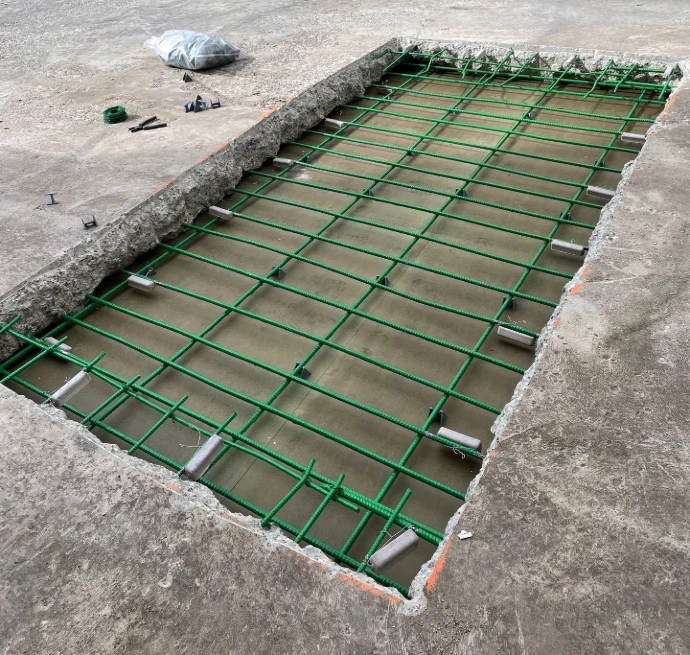
A new phase began in the 1970s when cathodic protection was applied to reinforced concrete. In the United States, solutions were sought for the corrosion of steel reinforcement in bridges and other concrete structures. In particular, the use of de-icing salts and exposure to marine climates caused chloride ingress in concrete, leading to rust formation of the reinforcement and concrete decay.
Cathodic protection has also proven effective here. By making the reinforcement steel cathodic, further corrosion could be almost completely stopped without the need to fully replace the structure. This represented a significant step forward in extending the lifespan of infrastructure.
Since then, the technology has been significantly modernised. New anode materials have been developed, such as titanium with a mixed metal oxide coating (TiMMO). These materials do not behave passively and have a very long lifespan, which has significantly improved the reliability of impressed current systems. Nowadays, cathodic protection is widely applied in bridges, car parks, tunnels, and even monumental buildings.
4. Current state of affairs
Today, cathodic protection is a mature and globally applied technology. The technique is used for:
Underground pipelines for oil, gas, and water
Storage tanks and cable systems
Offshore structures and ships
Reinforced concrete structures such as viaducts, tunnels, and car parks
Historical and monumental buildings
Although the core of the technology – creating an electrochemical cell in which the metal to be protected acts as cathode – has remained unchanged for almost 200 years, the materials, calculation methods, monitoring techniques, and installation methods have been greatly improved. Modern systems utilise advanced measurement and control technology, allowing the protection to be accurately monitored and optimised.
Cathodic protection has thus evolved from an experimental ship solution in the 19th century to an essential tool in contemporary corrosion management.