CATHODIC PROTECTION
Cathodic protection of steel in concrete is a technique to prevent or stop corrosion of reinforcement. By electrically polarising the steel to cathode, the corrosion process is interrupted. This is done using anodes and an external power source or via galvanic anodes. This significantly extends the lifespan of concrete structures and prevents further concrete damage.
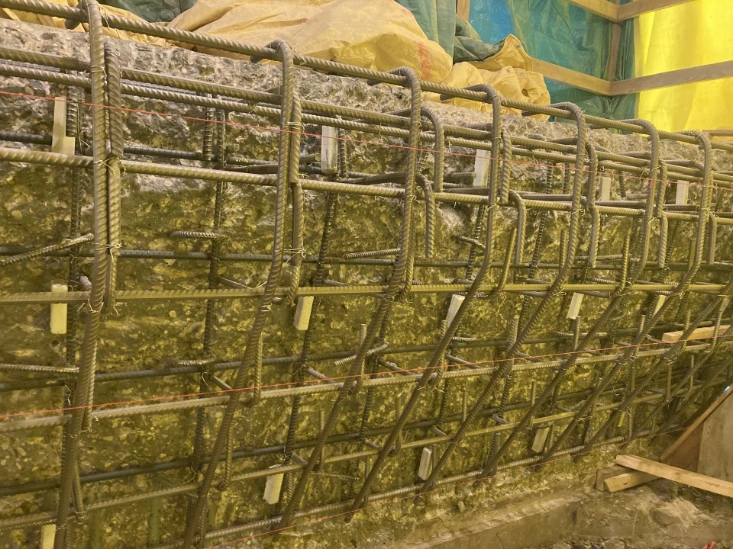
history of cathodic protection
The history of cathodic protection (CP) spans more than 200 years and began as a solution to corrosion problems in the British Navy. The principle is based on the electrochemical protection of metal structures.
Galvanic cathodic protection
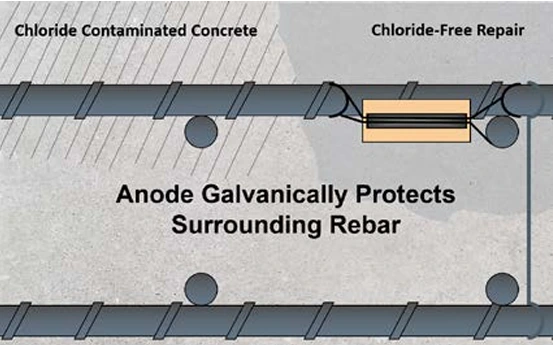
When two dissimilar metals are connected in concrete, the metal with the highest corrosion potential (zinc) will corrode before the nobler metal (reinforcement steel). Galvashield® anodes are embedded/drilled into concrete repairs, or at other locations where new and existing concrete come into contact, to limit corrosion in the adjacent parent concrete.
cathodic protection with
impressed current
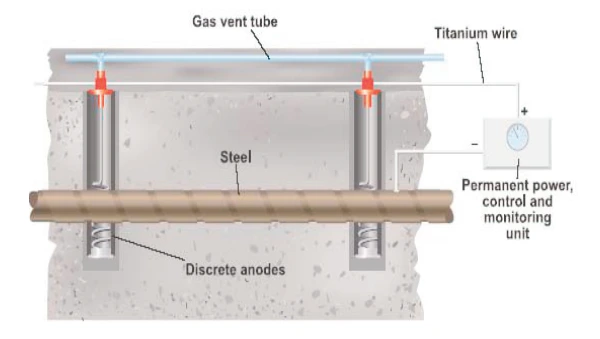
In ICCP (cathodic protection with impressed current) this rusting is stopped with electricity.
The steel in the concrete is connected to a small direct current.
Special anodes are placed on or in the concrete.
The current ensures that the steel can no longer rust.
The concrete slowly conducts the current to the steel.
You can see it as if the steel is being “protected” by the current, preventing it from being affected.